As a Korean watching this unfold — yesterday was genuinely historic.
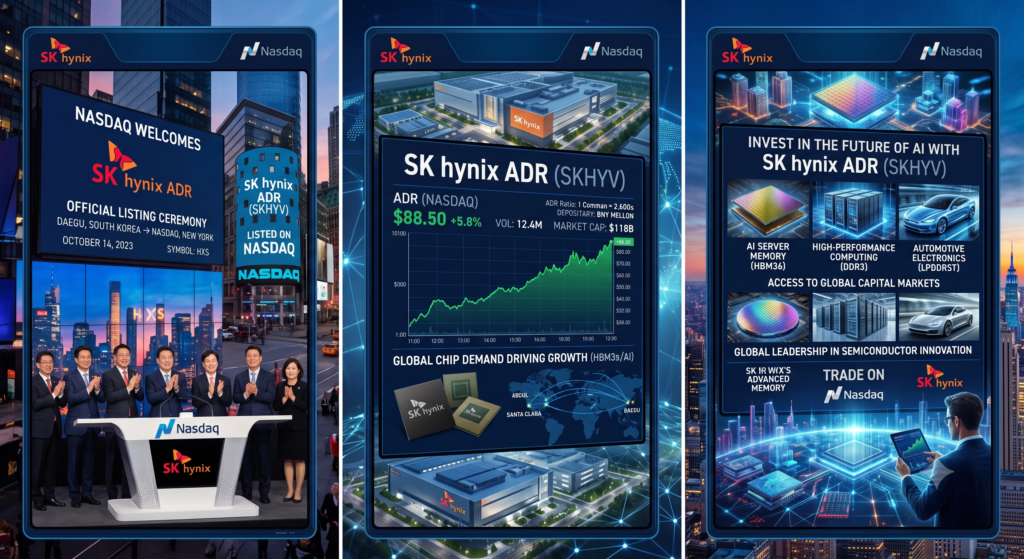
SK Hynix listed on Nasdaq under the ticker SKHYV on July 10, priced at $149 per ADR. Shares opened at $170 — a 14% pop — and closed the day at $168.01, up roughly 13%. Market cap crossed $1 trillion. The ticker will convert to its permanent symbol, SKHY, on Monday, July 13.
The offering raised $26.5 billion, making it the largest-ever US listing by a foreign company — surpassing Alibaba’s $25 billion raise back in 2014. There’s only one deal in history that raised more money in the US: SpaceX, which went public almost exactly one month earlier.
The Timeline That Got Us Here
This listing didn’t come out of nowhere. It’s the result of months of careful groundwork.
Back in March 2026, SK Hynix quietly filed for the ADR listing with the SEC. In April, the company lined up Citi, JPMorgan, Goldman Sachs, and Bank of America as underwriters. On June 24, SK Hynix formally announced plans to raise up to ₩45.45 trillion through the offering. The market had originally expected an August debut, but the process moved faster than anticipated, pulling the date forward to July.
Demand was extraordinary. Orders came in at seven times the available supply during bookbuilding — and roughly $5 billion of the offering went to three cornerstone investors: Baillie Gifford, Coatue Management, and Situational Awareness Partners.
Why Bother Listing in America at All?
Here’s the question every Korean investor has been asking: why would a Korean company go through all this trouble to list in the US?
The short answer: to finally get paid what it’s worth.
SK Hynix has long traded at a discount on the Korea Exchange — a forward P/E around 6-7x, compared to roughly 13x for its closest US peer, Micron Technology, despite what many analysts consider comparable or even superior fundamentals. SK Hynix holds 56.4% of the global HBM market, according to its own securities filing, and its chips power the AI processors built by Nvidia and AMD. Its customers include Nvidia and Apple.
By listing directly on Nasdaq, SK Hynix opens the door to passive fund inflows that have historically gone almost exclusively to Micron. There’s also a specific strategic reason the company chose Nasdaq over the NYSE — to position itself for inclusion in the Nasdaq 100 Index, which the market widely expects to happen during the routine rebalancing this December. Once that happens, funds tracking the QQQ ETF would be required to buy in automatically.
Proceeds from the offering will go toward expanding the Yongin semiconductor cluster, the Cheongju advanced packaging plant, and equipment purchases including extreme ultraviolet (EUV) lithography scanners. SK Hynix also announced a $4 billion advanced packaging plant in Indiana — though the vast majority of its expansion will still happen in South Korea, including a chip fabrication cluster in Yongin expected to cost roughly $390 billion over time.
What Exactly Is an ADR?
Quick explainer, since this trips people up. An ADR isn’t Korean stock being physically moved to America.
An American Depositary Receipt is a certificate representing shares of a foreign company, held by a depositary bank, that trades on a US exchange in dollars. Every ten ADRs represent one underlying SK Hynix common share listed in Seoul. In practice, it means US investors can now buy into SK Hynix directly in dollars, without needing a Korean brokerage account or dealing with currency conversion.
This was structured as a new share issuance — roughly 2.5% of total shares outstanding — rather than existing shareholders selling off their stakes. Existing Korean shareholders don’t lose their shares; they just see modest dilution from the new shares entering circulation.
How Does This Compare to SpaceX?
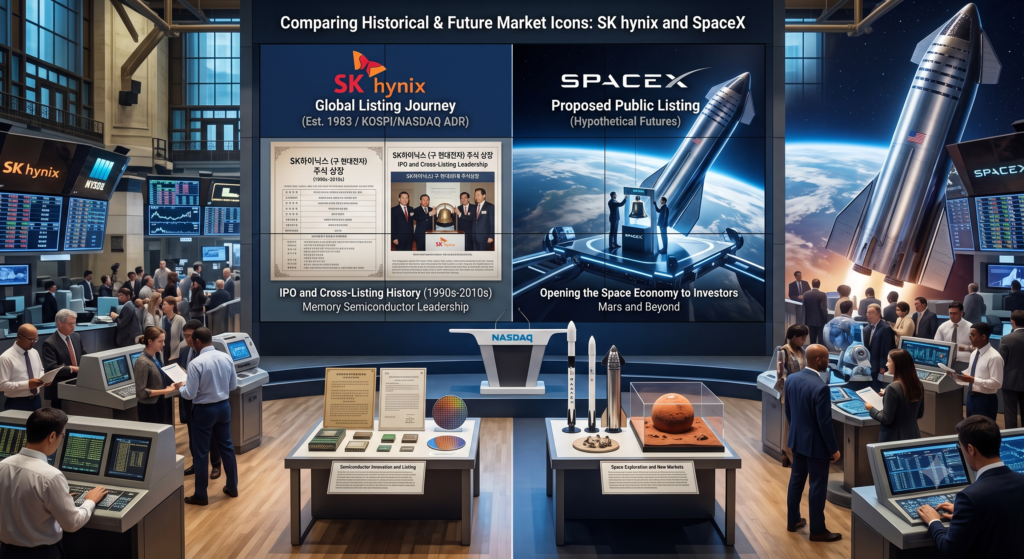
Putting these two IPOs side by side reveals some genuinely interesting parallels — and some sharp differences.
Both companies share a common thread: each was already the dominant, almost monopolistic player in its industry long before going public. SpaceX effectively controls the commercial rocket launch market. SK Hynix effectively controls the HBM memory market that powers the entire AI boom. Both spent years operating at that scale while remaining either private (SpaceX) or chronically undervalued (SK Hynix) relative to their actual market position.
But the structures couldn’t be more different. SpaceX’s offering was a pure new listing of a private American company entering public markets for the first time. SK Hynix, by contrast, was already publicly traded on the Korea Exchange — this is a dual listing via ADR, meaning the Korean stock (KRX: 000660) and the American ADR (Nasdaq: SKHYV) now trade simultaneously in two different markets, in two different currencies, often at two different prices.
Accessibility also differs sharply. SpaceX shares, even post-IPO, remain difficult for ordinary retail investors to access in meaningful volume. SK Hynix’s ADR, on the other hand, became instantly tradeable by anyone with a standard US brokerage account the moment trading opened — no special access required. That accessibility gap likely explains part of the sheer trading volume and retail enthusiasm on day one.
What the TSMC Precedent Suggests
SK Hynix has an obvious comparison point to study here: Taiwan Semiconductor Manufacturing Company.
TSMC’s US ADR has historically traded at a 5-8% premium over its Taiwan-listed shares, and during the peak of the AI hardware rally in late 2024 into 2025, that premium widened to as much as 25%. It’s remained close to 20% at various points since.
That premium exists because arbitrage between the two listings is difficult — both Korea and Taiwan maintain currency and capital controls that make it hard to freely convert between the local shares and the US-listed ADR. When arbitrage is constrained, extra US demand pushes the ADR price higher relative to the home-market shares. (Compare that to a company like ASML, based in a country with freer capital flows — its Amsterdam shares and Nasdaq ADR typically differ by less than 0.5%.)
UBS has explicitly recommended clients sell the Korean shares and buy the ADR instead, betting on this exact premium dynamic. HSBC has projected the ADR could eventually trade at roughly a 20% premium over the Seoul-listed stock — right in TSMC territory.
How the Market Reacted
The listing rippled across the entire chip sector. Nvidia shares rose 3.5% on the news. Rather than losing ground to a new competitor, Micron and SanDisk actually rallied alongside SK Hynix — suggesting investors read this as a vote of confidence in the whole memory sector, not a zero-sum shift.
SK Hynix Chairman Chey Tae-won rang the opening bell at the Nasdaq MarketSite in Times Square, telling CNBC: “It’s a kind of dream, and now it’s a dream come true.” He added that AI agents and physical robots will require enormous volumes of memory chips going forward, and that he doesn’t see signs of that demand shrinking — a direct response to skeptics who point to memory’s historically boom-bust cycles.
Analyst sentiment has been overwhelmingly positive. CLSA reaffirmed a “High Conviction Outperform” rating in a June 10 report, and Daiwa Securities raised its price target to ₩3.6 million with a “Buy” rating. Of 36 analysts currently covering the stock, 35 rate it a buy.
The Risks Are Real
None of this comes without caveats.
HBM contract pricing is facing downward pressure heading into the back half of 2026, and Samsung Electronics is accelerating its push into HBM4 to close the gap with SK Hynix. If AI infrastructure spending slows even modestly, HBM demand could take a direct hit. Now that SK Hynix trades on Nasdaq, it also faces constant, direct valuation comparisons against Micron in a way it never did while trading only in Seoul.
There’s also the dilution question — issuing new shares to fund the ADR offering means existing Korean shareholders now hold a slightly smaller slice of the company than before.
And some observers are simply cautious about chasing a memory rally at all. As one skeptical voice put it: memory always behaves this way during a megacycle — the concern is that “it always crashes hard” eventually.
My Take
As someone who holds SK Hynix in my own portfolio, I see this listing as more than a single trading event. It’s a direct challenge to the “Korea discount” that has followed this stock for years.
A company that effectively controls the global HBM supply chain has finally positioned itself to be valued the way a company in that position actually deserves. SpaceX became the symbol of the modern space industry going public. SK Hynix may end up as the symbol of the AI memory era doing the same.
Whether the ADR premium eventually climbs toward TSMC’s 20-25% range, or gets weighed down by dilution concerns and HBM pricing pressure, is going to be one of the more interesting stories to track in global tech markets over the next year.
— Your Korean insider 🇰🇷